Indiegames are Dead
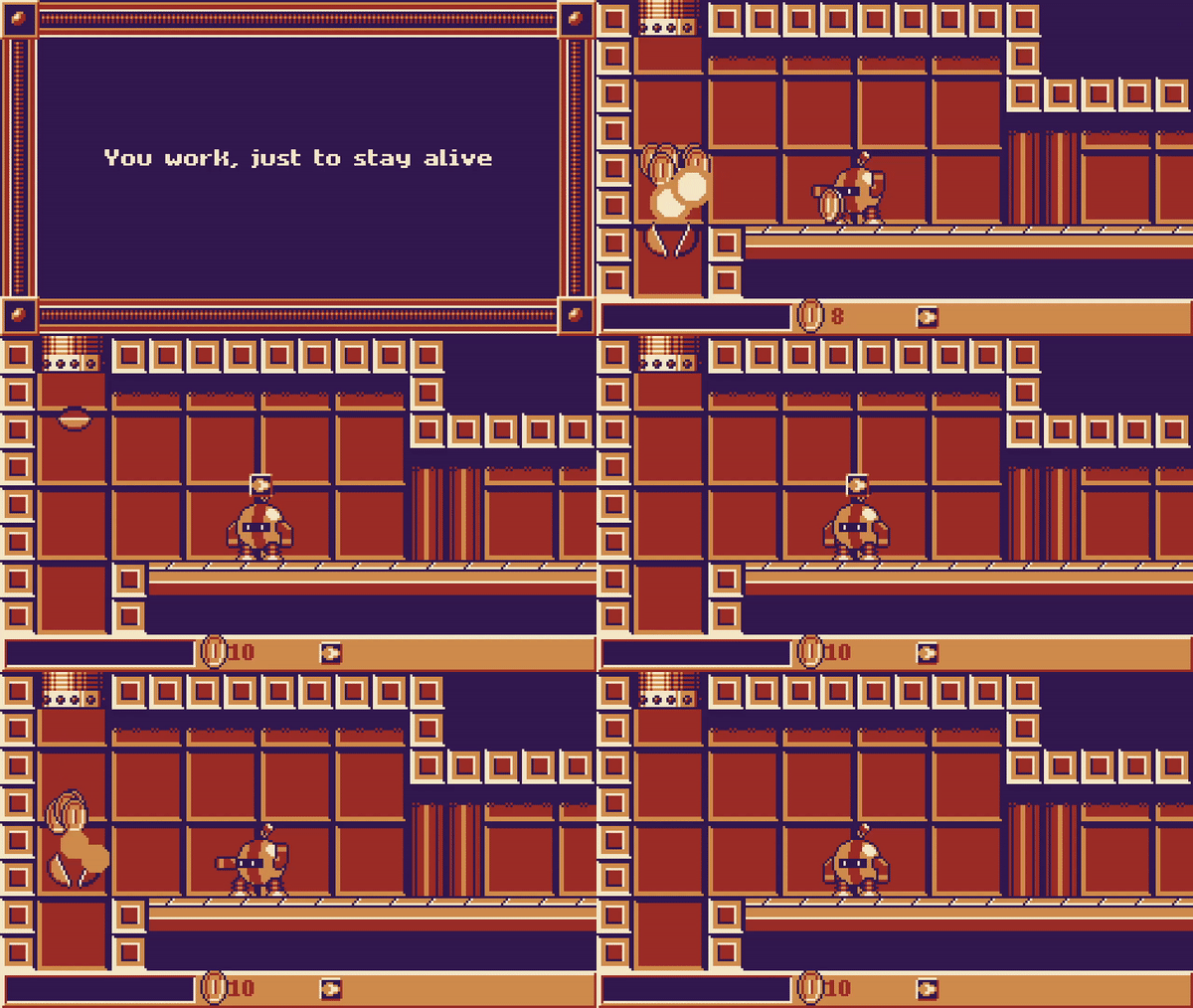
It is my position that "Indiegames" as it started to appear in the late 2000s does not exist anymore and what we see today, and have been seeing over the past decade, is instead a husk, driven forward by financial interests first and foremost. A husk, that in its claim to unify all videogames that fall into a specific mode of production, is actually doing substantial harm specifically to works that are smaller in scale, of experimental nature, or otherwise less commercially viable.
I already kind of wrote about this in 2022, but mostly focused on Steam's structure and how it would lead to the creation of a "Deadzone". I took this term from Max Haiven's book "Revenge Capitalism", but I've recently re-read that specific chapter and feel like this attempt of mine back then, missed a few important points. So here I am giving it another go.
Let's start with summarizing the main characteristics of a Deadzone, as Max Haiven describes it:
Quote:
"In general terms, my conceptualization of the dead zone describes as unintended but disastrous collective consequence of the kinds of market-oriented behaviors encouraged by financialized capitalism. In this paradigm, economic exploitation and social order is not simply orchestrated "from above" but instilled in and activated through many individuals, each of them motivated by the pressures to compete in a society where everyone is expected to transfigure themselves into a speculator, which seeks to recode all relationships as risks and where we are taught to imagine everything of value as an asset to be leveraged."
It describes vindictive, financialized structures not as the result of sadistic individuals, but as the result of the dynamics of the systems themselves and can be categorized by the existence of the following characteristics:
- Structural Violence and Interpretive Labour:
- Actors within the system are geared towards a financialized form survival
- The destruction and subsumation of existing communities through the influx of capital and its desire to shape space around its own specific interests
- The creations of a kind of exhausting overstimulation via addictive, meaningless interactions, and the requirement to participate in it
- A constant fear of, and desire to take revenge on a marginalized Other
Actors in the system are suppressed by its intransparent bureaucratic structures and they are required to perform specific acts in order to avoid getting punished by it.
While financial institutions do put pressure on economic systems to follow their desires and guidelines, the deadzone forms when this way of thinking is being adopted by the majority of actors within it, regardless of whether or not it actually serves their interests.
Obviously there's a bit more to his overall argument, but the purpose of this text, is to (hopefully) demonstrate that what we're seeing on Steam, and what we broadly understand under the term "Indiegames" these days, is in fact one of these Deadzones.
Indiegames grew out of the existing amateur and hobby communities that existed in the 2000s, which were financialized and subscequently collapsed with the emergence first of digital marketplaces and later with the emergence of "Indiegame Publishers". These days, it is difficult to find any community for game developers, that isn't mostly being used as a vehicle to market yourself, your skills and/or your products. Discussions about design practices and approaches are heavily geared towards what is commercially viable and likely to succeed. And while most of these things are centered around Steam, it is not exclusive to it. Look at Itch.io's main community forum and you see scores of people who are playing the same kind of game, with the same kind of rhetoric, but with even less chance of ever getting anywhere.
Steam however, is where these other characteristics become most apparent.
Let's assume I want to release a game on Steam in the year 2026.
First, I would have to pay an entry fee of $100, which in theory I would make back, once the game has earned more than $1000. I would then have to set up my Steam page, following a very tight set of rules that govern not only which information I have to present, but also its shape. I will not be able to release a game on Steam, unless I am able to tick all of these boxes and my page is approved by someone. Who that person is I don't know, I just get an email that informs me about the state of the process.
I then have to go through the same process, but this time for my game's build. Once it is approved, I could then release my game.
That is, if I would like it to make no money at all and waste away in total obscurity, because Steam has more rules that you need to follow, that it never tells you anywhere and are only known via rumours and assumptions.
For your game to do well, you need wishlists, a lot of them. In order to get these wishlists you need to publish your page ahead of time and present the contents of your game in such a way that it compels the visitor to add it to their wishlist.
You also probably should do a Demo, preferably during one of the Steam Next Fests. That Demo should be at least an hour long, or so I've heard and should really present the game in a good way. It might be even worth it to spend extra time just on the demo.
Sidenote: Remember those stories over a decade ago, about how ridiculous it was that AAA studios sometimes spent more than a year on Demos just for E3, that sometimes had stuff in them that never made it into the final game? Well, these days we're expecting this not only from studios with hundreds of people in their employ, but from everyone. Isn't this strange?
Once you've lived through that ordeal, and also managed to actually finish your game, you can then release it. And immediately start the process of begging for positive reviews, the actual content of which don't matter. Rumours have it that Steam does something with the visibility when your game reaches a specific threshold of positive reviews. However, there are also other rumours abound that while Steam does check for reviews, it also cares about average playtime, which might bite you in the ass if you happened to have made a game that is short and can "only" be played through once.
It is also likely that someone will show up in your Steam Forum to ask about how many hours of content you're offering per dollar and the entire time, there's this lingering fear in your brain, that if you're accidentally too rude to these people, you might summon the really wrathful gamers upon you.
So, releasing a videogame on Steam in 2026 isn't really just about making the game itself and trying to get games media to cover it. It involves an entire mountain of arcane systems and social norms you have to navigate, social systems you need to engage with, that only care about the engagement and not the content of said engagement and because it is so opaque, there's no way of knowing if your poor sales are because you made a mistake, or because you were just unlucky.
But, since we've all been turned into financial actors and the "Indiegames community" has been turned into a marketing phrase, we don't see other developers as potential allies in navigating this system. They are our enemies. Flooding Steam with their games, playing the algorithms, exploiting loopholes, not playing fair at a game that no one understands the rules of.
For a long time I had the belief that the issues you see on Steam have nothing to do with the amount of games that are released there. In fact the amount of games is just an expression of the larger structures around it. When industrial fertilizer gets pumped into a lake, it will cause an algae bloom, which over time kills everything else, including the algae themselves. Games on Steam are not the fertilizer, they are the algae.
When a space gets financialized and the world itself turns everyone into a tiny business, then eveyone will run towards the one marketplace that seems to offer them the best chance of survival. Of course this will choke everything out, but the failure doesn't lie with the people who came to it slightly after the first wave.
It lies with the structures that are built such that you can't understand their internal workings and the systems that profit off them. You yell at the many games that are released on Steam and thus contribute to the culture that also motivates its user base to play community police, because it is the one obvious number that keeps increasing.
Here we loop back to what I said back in 2022 already. You, as a developer are faced with a choice here: Either you try your best to appease these strange systems and play the same game, or you die.
However, this is something I missed back then and that I think a lot of people are still missing:
Nothing lives in a deadzone. If Steam, and Indiegames in general, are a Deadzone, then anything that exists within it is either already dead, doomed to die, or is feeding on the detritus at the bottom, and thus introducing even more toxins into it.
Indiegames are dead. What we see today is a corpse that is being driven around by financial interests, keen on producing a never ending chain of repetitive, meaningless interaction machines and to enter it either means death, or to turn into one of the worms that pilot it.
This is not the fault of any singular person. It is the result of a systemic and historic process. Sure, humans propelled this process forward, but many of those that act within it, are doing so, because they can't see any other way. The Deadzone after all, also exists within us.
So how do we go on from there? Do we yearn back to the old times, of Forums and small communities. The magical "old web" of the year 2006? While these things are nice and can offer a reprieve from the stinking swamp we find ourselves in, I don't think that we can fix the present, by turning to the past that gave birth to it. If the Deadzone exists within us and is perpetuated through us, then just moving into a different space won't be enough.
We first need to reject the things that kill us. We need to reject the empty interactions, we need to stop appeasing vengeful structures that cause us to see our comrades as our enemies. There is a value in shared struggle that goes beyond the simple idea that it's easier to reach my personal goal with the help of others. It is how we shape connections and build better, healthier structures that support these connections. I believe that this is possible, however I also believe that it cannot happen in the space that kills you.
In case you're interested, I had some more lose thoughts about this topic. I collected them in a separate post, that can be read here: