Not everything has to be about the player's feelings
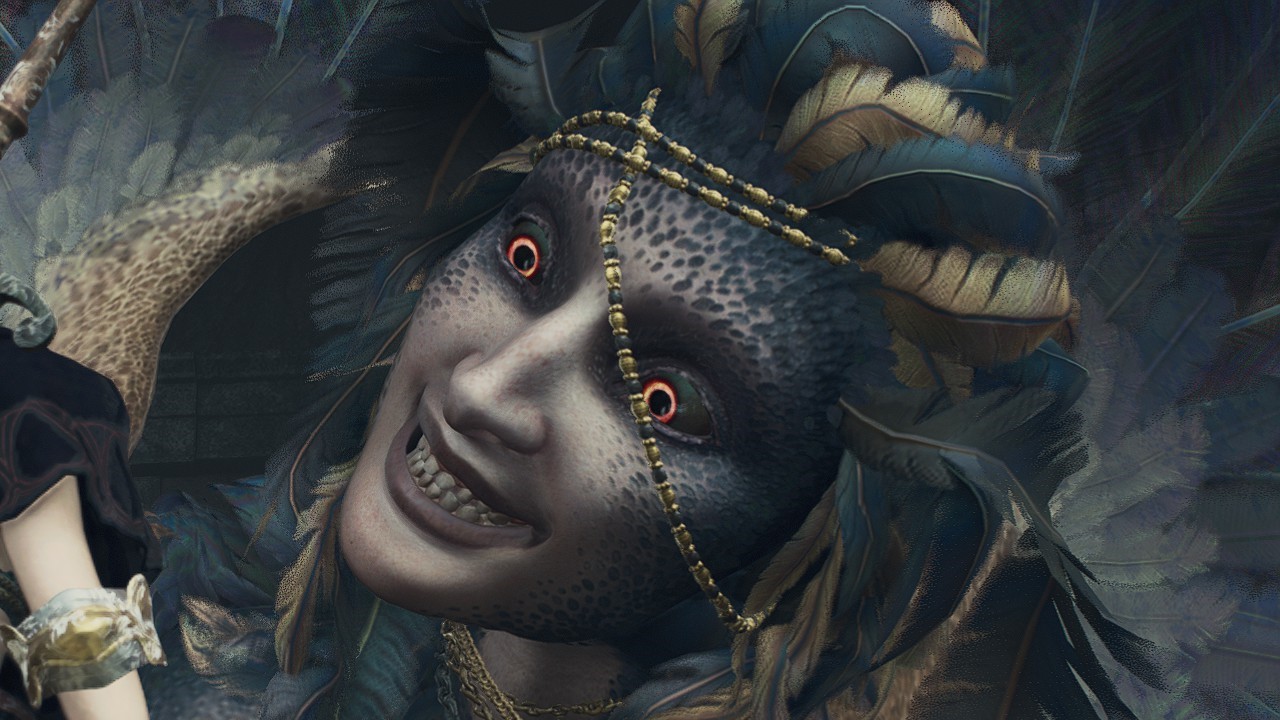
You really think something magnificient as this is "friction"?
Why should games be belligerent to its players? Tanya X. Short in a blogpost that was published a bit more than a year ago, had this to say about this subject:
"It’s dangerous, of course, to stand up to such a powerful entity as The Player — usually, The Player is the closest thing to a god in these little realities. The game does what they expect it to do. Whether the core loop is building a farm or shooting bad guys, most commercial games are different flavors of escapist fantasies. Even when power and domination don’t play an active part in that fantasy, players like to feel in control. Most of the time, our job as game designer is to make sure input is carefully related to output in a way that creates the impression that the player can predict the outcome of their various decisions and actions. Interfering in that feedback loop is playing with fire. A disobedient game character or system can be frustrating, even if used well. Ultimately even in the best case, it’s more of a flourish, a flex, not a reliable core mechanic. "
Everyone within videogames knows the term "Games as a Service", but we mostly use it when we talk about the business model of games that are aimed to provide a continuous experience to its players. However, you cannot run a Game as a Service, when you don't also design it as such. I compare this type of approach to something similar to a Restaurant, where customers are sold an illusion of comfort that actually requires a lot of effort to keep up. We all know the stories of angry restaurant customers, who love to yell at service workers and in a way, the most vocal elements of videogames are very similar both in their expectations as well as their tone when they are not met.
We have a big problem with videogames in that most voices who get to talk about game design as a craft are people who are very good at one very particular kind of game, those that are commercially successful. This also applies to games criticism, where even those pieces that do try and look at games from an angle that goes beyond treating games as consumer products, mostly look at games that come out of that very specific, industrialized part of videogames culture.
Over time, and subjectively I feel this has gotten much worse over the past 10 years, this has lead to a very stagnant idea of what a videogame actually is. In the landscape of 2026, a videogame can only be a Restaurant. Everything orbits around the player, even elements that sound like they might go against the player's interests are framed such that they are actually good for them.
When Dragon's Dogma 2 came out, I almost lost my mind when I kept seeing people describe the more idiosyncratic elements of its design as "friction". I've since started to really dislike this term and this relates to this idea of games as a Restaurant. The term "Friction" only makes sense, if you consider the ideal state of a videogame to be one where everything within it works to service the player's interests and desires. From that point of view, "friction" is any element that disturbs those smoothly orbiting systems and reminds the player that what they are experiencing is the result of human labour. A wonky fast-travel system in that sense is like the waiter who takes a bit too long to take your order, or the food that is slightly overcooked.
While this perspective might be of use for specific types of games, it does not apply for every one. Games are not Restaurants, they are a medium. On one side you have the people who create it, and who have a specific thing they want to communicate to the player. The path this communication takes is determined by the game they are playing. This could be a Restaurant, but it could also be something completely different.
The reason I'm mentioning this, is because I think that this very specific perspective is harmful. If we only ever think of games as Restaurants, then all we will ever get are Restaurants. In this environment, the only new ideas that people can come up with, will be new ways for both players and designers to mutually exploit each other.
I don't think I ever thought of my games as things that are built purely around its players. Especially my larger games all have elements in them that are deliberately pushing against the player, because I don't consider their comfort to be sacred. If a character in my game is experiencing something unpleasant, why should the player be exempt?
That doesn't mean that they don't matter. While games can exist without players, I do think that it's the addition of the player as an agent of chaos that actually makes them interesting.
Think of a game's systems as a solar system without a Star. You have several different elements, that each have their own gravity, but are mostly floating around on its own. This changes once the player enters it. Because the player is moving through the game and in doing so will affect the various systems and elements with their gravity. The system that was previously static begins to move.
An industrial game is mostly built such that the player's motion will cause every other element to orbit around them, instead of floating around in space. The final goal of this design is to create a stable system, either with the player at its centre, or with the player orbiting around a much larger structure, while being in control over several smaller elements.
This is a videogame as a Restaurant, because Restaurants too are built such that the entire space and every actor within it begins to circle around the customer.
Now, what if we don't build it like that? What if the player has less mass? They will still affect the elements they pass by and will be affected by them, but at no point will they enter a stable rotation. Instead they will leave the system, but because of their presence and their path, they leave it in a fundamentally different state than before.
Here the player is a visitor, someone who temporarily shares a space with other elements and through their motion enacts change on their environment, but is also changed by it.
In both instances the player has a substantial impact on the development and final state of the game, however the first approach only ever knows one final outcome: Stability around the player.
The second approach, while certainly being more messy, comes with the benefit of offering a much wider range of outcomes. It will however most likely also be a bit more unpleasant to the player.
To go back to that quote from the beginning: Maybe we shouldn't think of the players as Gods. Regardless of what kinds of games you want to make, I don't think it's a healthy perspective. Players, like all of us, are just people, and we shouldn't treat them any different. A lot of pleas for more different types of games at some point utter the phrase "games can be so much more!", when they already are. However, if all you ever learned is to look at Games as strange digital Restaurants, than everything you encounter will be treated as such.
So instead, we should stop looking at games as only being one very specific type of experience. We should start treating game design as a dynamic, intentional process and not a set of rules every human being under the Sun has to follow and that only ever applied to a very specific subset of works to begin with.
And maybe, just maybe, we should let more people talk about this kind of stuff other than those who can afford to attend an invite-only event in Canada for affluent game developers.
This post is somewhat related to my previous post about "Evil Game Design":