Announcing the "Other" JRPG game
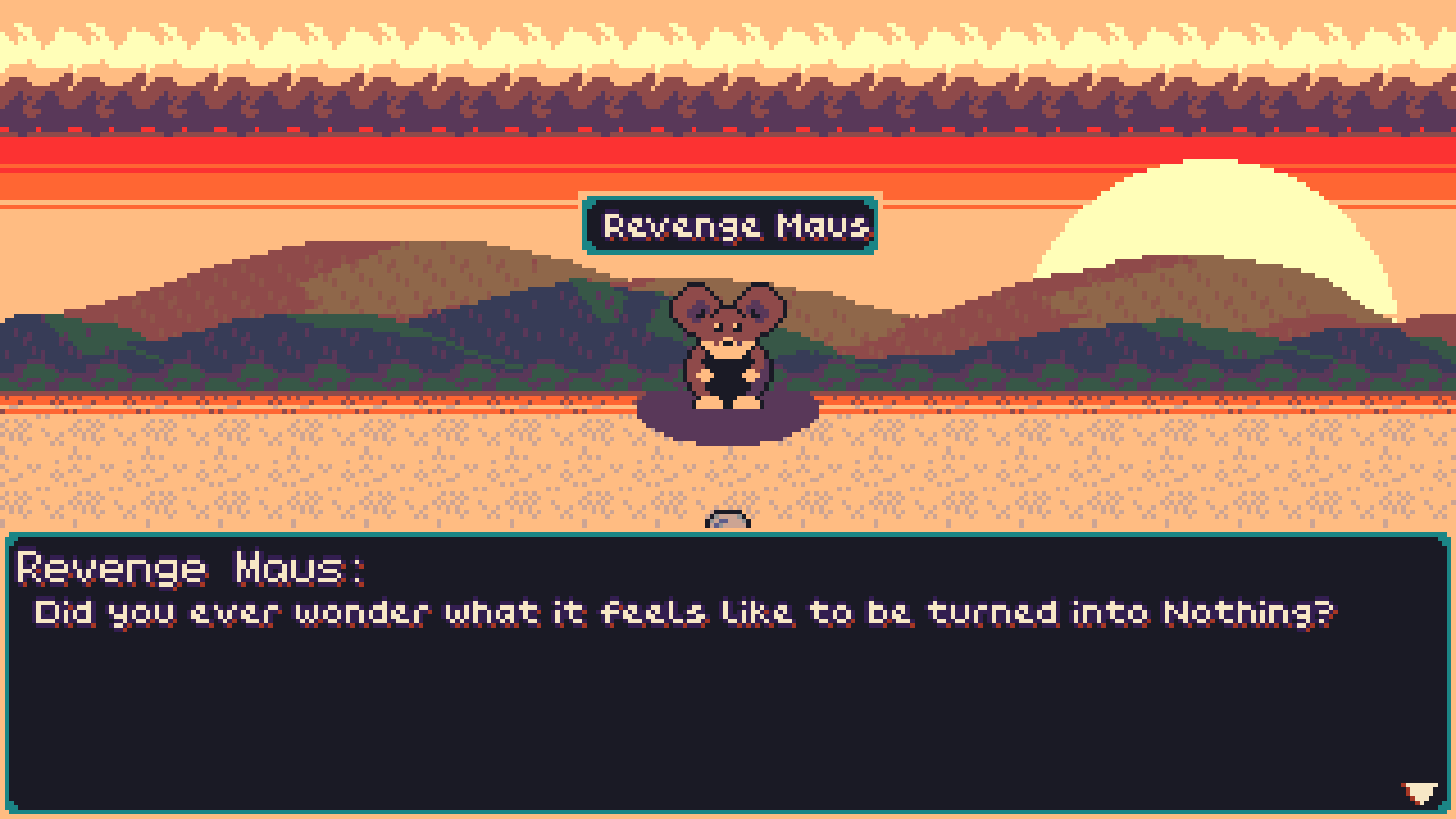
I announced a game yesterday. It's called "Eswahr Eternal" and it's a JRPG where you play someone who is destined to become a King. If you've followed my work over the past year and see me talk about "JRPG game" for a while, this is not the same game. "JRPG Game" is the game that's called "Leid vom Meeresfall" (an early version of which you can play on itch). "Eswahr Eternal" is what I called "other Rpg", because it was the other RPG I started working on.
Back in May I found myself in a situation where I had started to pitch Leid vom Meeresfall to publishers (something I still need to get back to again soon) and while I was waiting for the rejections to trickle in, I felt it wouldn't make much sense to push on with that project, without really knowing the scope I could plan for. I also felt that with the way that game was planned and laid out, it basically reached a scale that wouldn't be very realistic for me to make on my own in a reasonable amount of time. After Virtue's Heaven, I really didn't feel like jumping into another half-decade long Mammoth project.
Then one day, I watched a Dragon Quest 1 speed run and thought "there aren't really that many rpgs out there where you just play as one character" and I started to think about what you could do with that.
I made some plans and about two days later, I had the basic foundation in place to actually start building what I had in mind.
Almost all of the underlying systems for Eswahr Eternal are either direct transfers from Leid vom Meeresfall, or slight variations of things I made for that game and I think being able start building this game really quickly, certainly helped with my decision to shift my focus towards it for the time being.
It also helped that from the start I decided that I would work alone on this project. I wanted to keep it small and I also didn't want to worry too much about the commercial side of things.
So things went along rather quickly and at some point in mid-July something happened that I haven't experienced in a long time: I couldn't stop working on this game. For the past few years, it usually took me quite some time each day, until I was actually ready to start working. However, for the past two Months, I regularly had days where I started very early in the morning and kept working for the rest of the day, and sometimes even into the evening.
While this lead to the game coming together incredibly quickly (I essentially build around 80% of it within the last two Months), I'm fully aware that this pace is neither sustainable, nor healthy. In that sense, I'm glad that things have calmed down a bit recently, and at least these days I'm disciplined enough to take breaks and go to bed at a reasonable time.
At this point, almost the entire game, aside from the final act, exists. Obviously there's still a lot of fine adjustment work to do and some things are definitely more uneven than they should, but there is a game that you can play, and not just a set of environments you can walk around in.
I've said this a few times already in the past, but I'm so happy that I made this decision to make RPGs, instead of action games. Everything feels so much more fun to do for me, ideas come to me more easily and are easier to implement and I actually have more capacity to push myself. This is the first game where I actually started to enjoy making art for and it's because I've been pushing myself to work with more colours and more detail. It also helps that I refuse to animate most of my drawings, because I really feel that these types of games don't need that much animation to begin with.
With all that being said, let's talk a bit about the game and what it's trying to do and how I'm going to approach its production and everything else.
For a while now I've been fascinated by the idea of having a very close connection between fictional archetypes and the metaphysics of the world they inhabit.
If you look at the presentation of a "King" in most Fantasy Roleplaying games, you can see that the fictional creature "King" can mostly be described as an old Man who lives in a Castle and "rules" over "The Land". There's a very funny occurrence in Dragon Quest 5, where a character who you first meet in the shape of some guy with brown hair becomes a King later on in the game, and upon ascending the throne, his sprite changes to that of the regular Dragon Quest 5 "Old Guy with a Crown" King-sprite.
This got me thinking: What if, upon taking the Throne, the person who takes it ceases to exist and instead they get transformed by the Land into a "King". The "King" here then isn't a specific person, but a specific type of being. An expression of the Land's history and desire to keep existing. In a way, this is what happens to real people who come into power. In order to become a ruler, they have to shape themselves around the demands and requirements of the state they wish to govern and thus they become somebody else, to a degree.
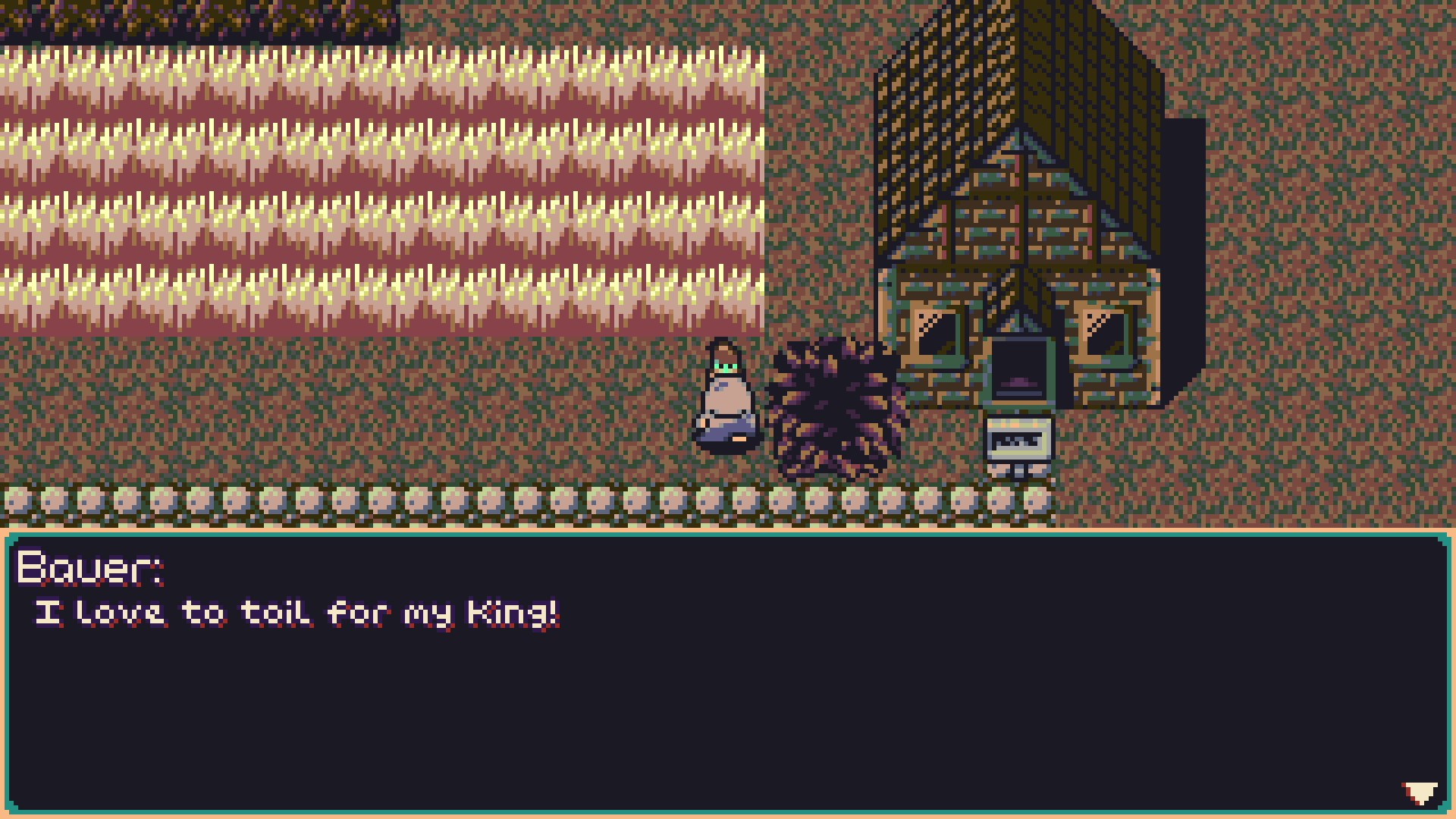
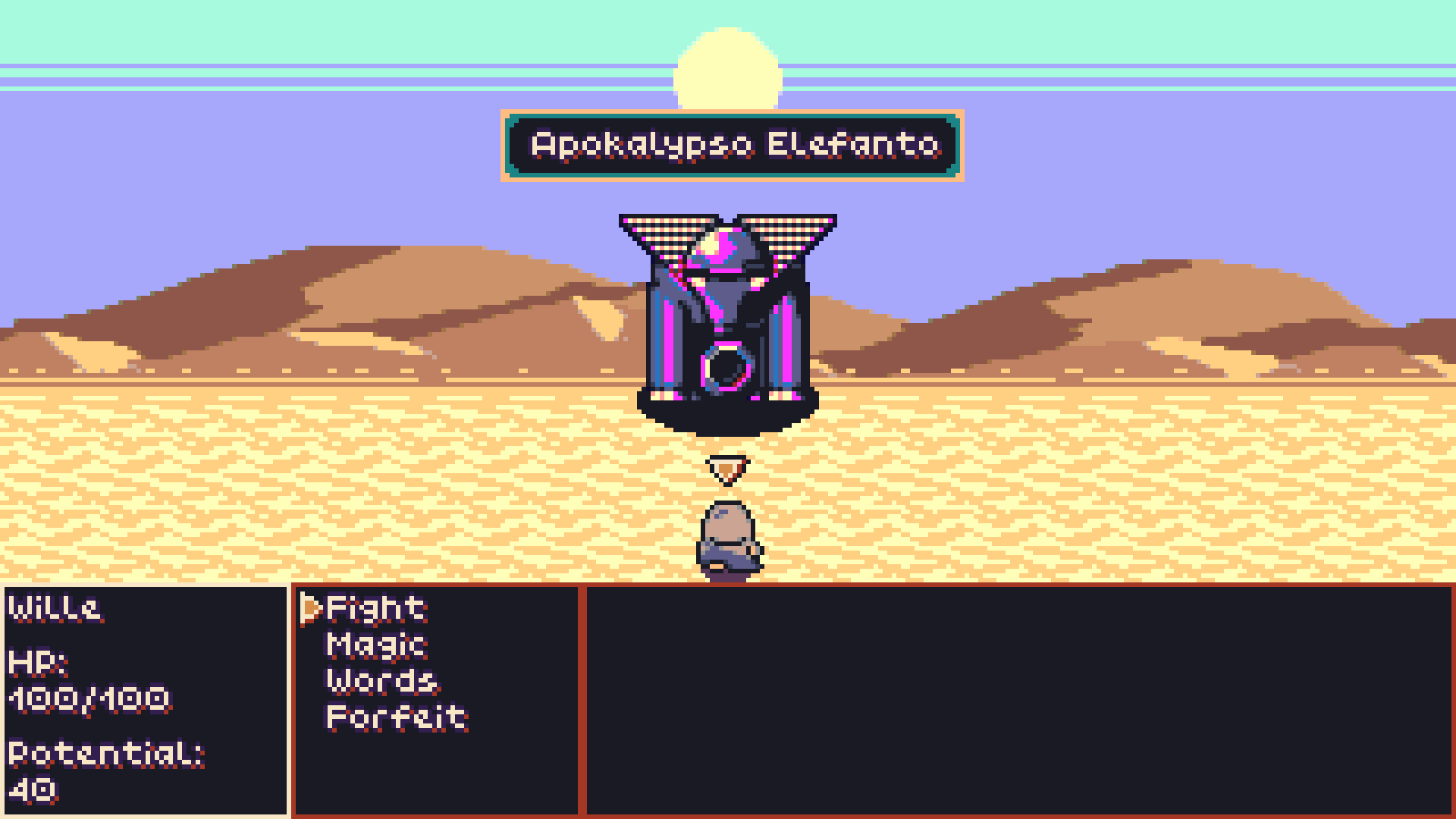
So this is what Eswahr Eternal is about. You are a Wanderer who has come into this eternal Kingdom (btw. "Eswahr" is a compounded and miss-spelled version of the German for "It was") from somewhere else and the Land has chosen you to be its next ruler. All the challenges you have to overcome are build such that by doing them, your character will slowly be shaped into a King. The game's main "Quest" has you travel around to slay the Land's four "Giants", and each time you do so, you have to sacrifice one of your five principles, to create an object of power. You need these objects of power in order to gain access to the Castle, where you will find the old King whom you will have to fight and kill. Depending on how things go, you might get a chance to use your final principle to shape the nature of your Kingdom.
Obviously the way this game is structured is very much shaped by all that "Evil Game Design" stuff I've been talking about, though I'm sometimes concerned that people might severly misunderstand its purpose.
I'm interested in mistakes. One thing I love a lot of Indie-tabletop RPGs is how their structure leads to you, as a player, being equally interested in the good, or bad outcomes of a roll, because they are all build such, that the story just keeps going forward.
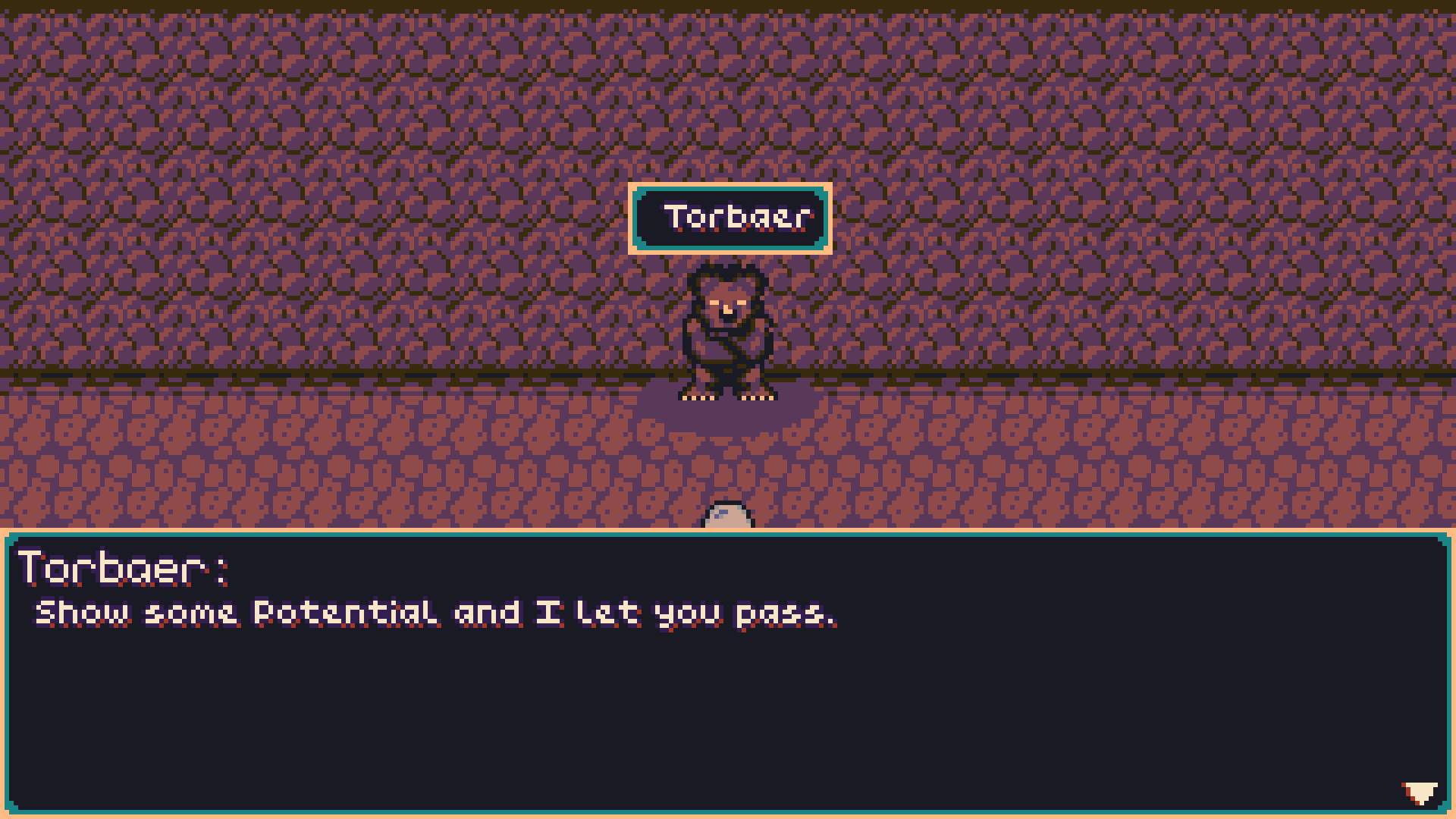
Videogames hate mistakes, that's why they reset players to checkpoints, or throw a game over into their faces. It's easier to have the player try again and hopefully do it "correctly" this time, then having to figure out how to deal with the fact, that the supposed hero of the story just got eaten by a Frog.
So for me, all that talk about "Evil Game Design", aside from making fun of the dorks who think that "Good Game Design" is a thing that exists and is worthy of pursuit, is to create a framework that (ideally) leads to games where players will make more mistakes and more importantly, they have to live with them.
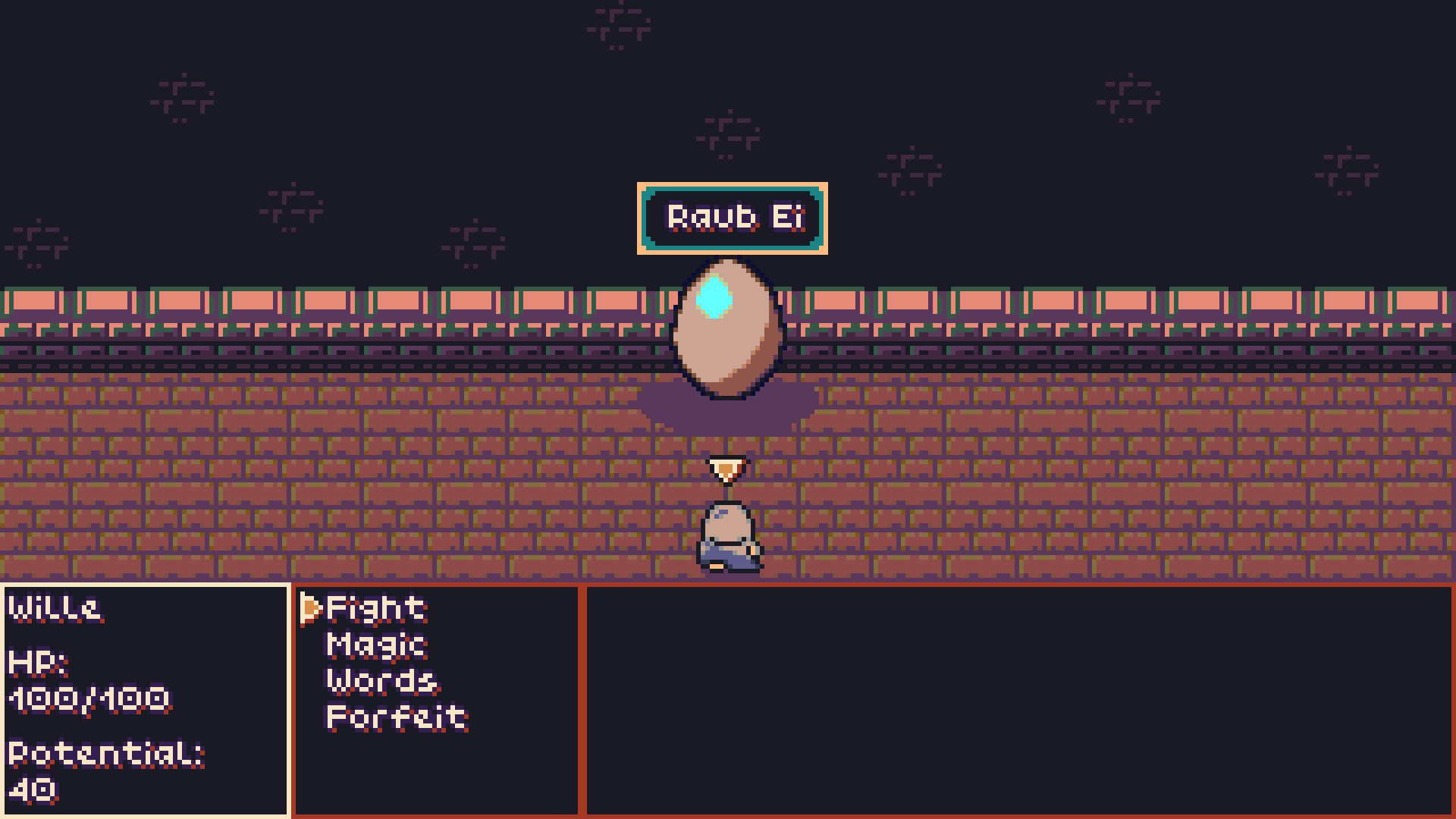
Eswahr Eternal is a very permissive game. The entire world map is open to you from the start. Almost all of your abilities will work on every enemy. You get a very cheap instant death ability very early in the game. Losing a battle will not immediately send you back to town. You can keep using abilities, even if you don't have the resources for them. As long as it's not a surprise attack, you can just quit out of most random encounters.
However, the game also doesn't explain itself at all. You don't know where to go, you don't know the intended level range for any given area. Most enemy stats are invisible to you, so until you've started a fight, you have no idea, if it's actually one you can reasonably win, or not. There's only one town and no fast-travel system, so sooner or later you will be very far away from safety with not a lot of resources.
So, all the time you kind of have to make decisions based on incomplete information and often, the consequences of these decisions are not directly visible.
I had a test-playthrough of mine last Saturday go horribly sideways and while it was unpleasant sometimes, I was delighted to see that the game was able to compensate for everything that went on (mostly, it did crash on occasion).
At some point I realized that what I have right now looks very much like a nice, breezy, short JRPG, but hidden underneath it are so many different ways that will eventually get in the player's way and derail things. I don't think there's anything in that game that doesn't have some kind of hidden extra thing that either works in the player's favour, or just does the exact opposite of what they want.
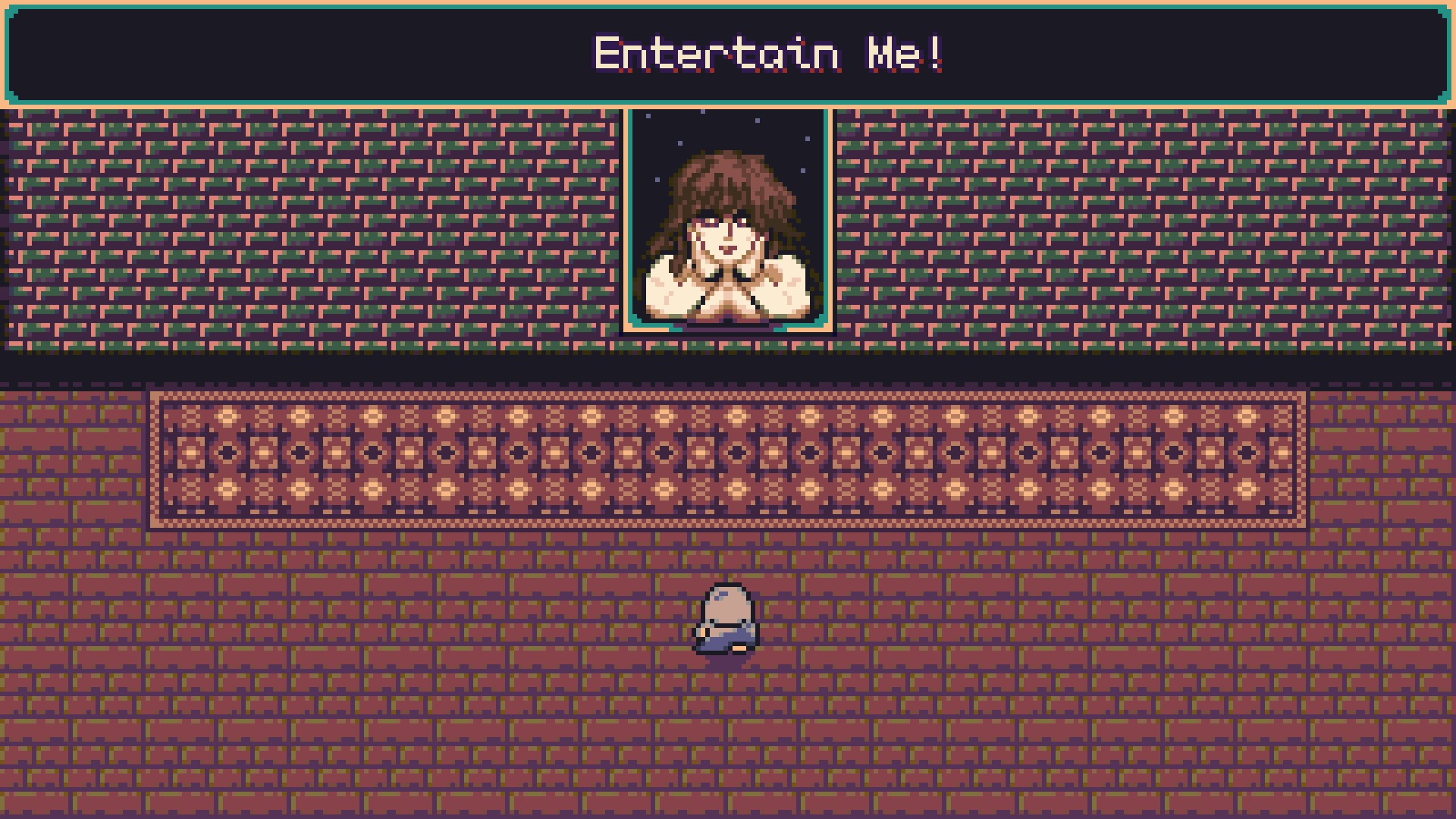
The game never really lets you get comfortable with one specific approach. Something, somewhere will get in your way and force you to look for alternatives, which exist. They might not be obvious, but you can find a way.
This isn't going to be for everyone and that's fine. I don't want this to be something for everyone. In fact, I'm trying my best to make sure that "everyone" will run away from this thing as quickly as possible.
I tried to build the game's steam page and presentation around what I personally feel it needs, and not fall into the trap of following the usual best-practice guidelines. These guidelines, after all, are build around attracting the "average steam-user" and aside from this being a non-existent person (statistical-people aren't real people), the type of player this term tends to describe is the last person I want to have to deal with, when it comes to this project.
I also published the game's Steam page on a Sunday evening, because I noticed how I started to get stressed out about that whole "plan the announcement" thing, when I actually had everything in place already. What better way to silence the little business jerk in your brain, then to start that whole process at probably the worst time possible?
I also went into Steam's back end and did, what I probably should've done a long time ago:
I applied cosmetic ublock-filters to both the game's wishist numbers and its page view stats. This doesn't make it impossible for me to look at them and get needlessly obsessed, but it creates an initial barrier that hopefully prevents me from getting too deep into the weeds.
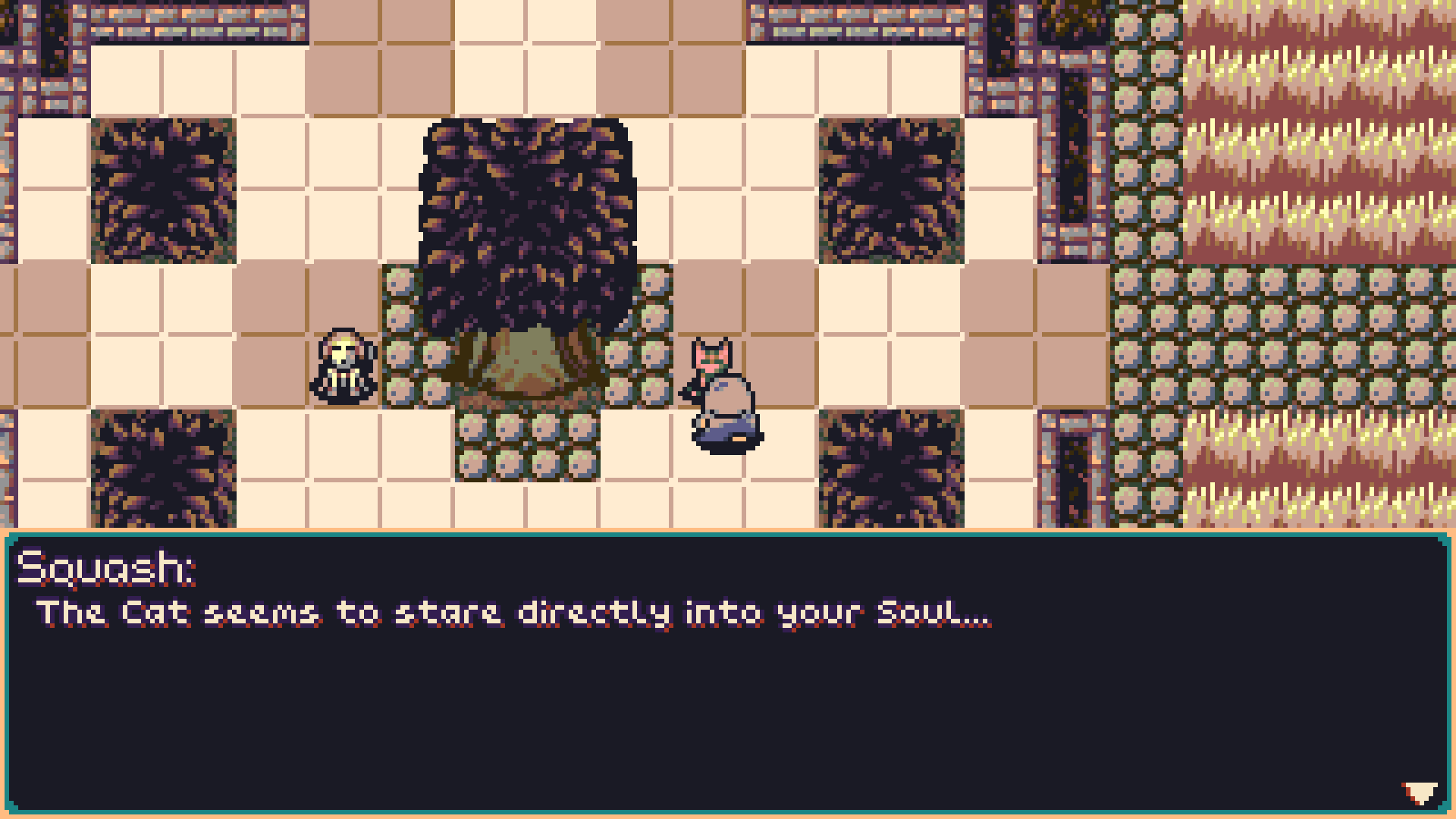
My goal is to release this game without even once having looked at my wishlist numbers, or page views.
This is a game for me. I want to be in control over when I talk about it, how I talk about it, and when I release it. I want to present this game in a way where I feel it fits its nature, and not in a way that might potentially increase some abstract number that likely won't matter anyway.
At some point on Sunday morning, I was a bit doubtful about the whole thing. Announcing a game and making it more "real" is always a risk, because suddenly you get a better idea of how that thing you've been working on and excited about, might be received by others. However, I then remembered that I'm making a videogame, and that videogames is full of people who spent days yelling at each other about the virtue's of yellow paint on environmental objects and thought to myself:
"The world deserves this."
Yes, I'm making this game for myself, but also because it needs to exist. I want to invite you all to come along with me, just make sure that you bring your own food and please don't anger the Mice.
I might not look at the numbers, but you're still very welcome to wishlist Eswahr Eternal on Steam. You know, for the SEO:
https://store.steampowered.com/app/5198420/Eswahr_Eternal/