On Saturday, July 11th, 2026 I had the pleasure to give a talk about "Evil Game Design" as part of the Glasgow Independent Games Festival. The talk itself was recorded and will appear on Youtube at some point (at least I hope it will), but I got impatient and thought I might as well post my slides as well as a transcript of it here. I will update this post once the talk itself is up, but until then, you are free to read this script and imagine it being presented in a strange almost German accent.
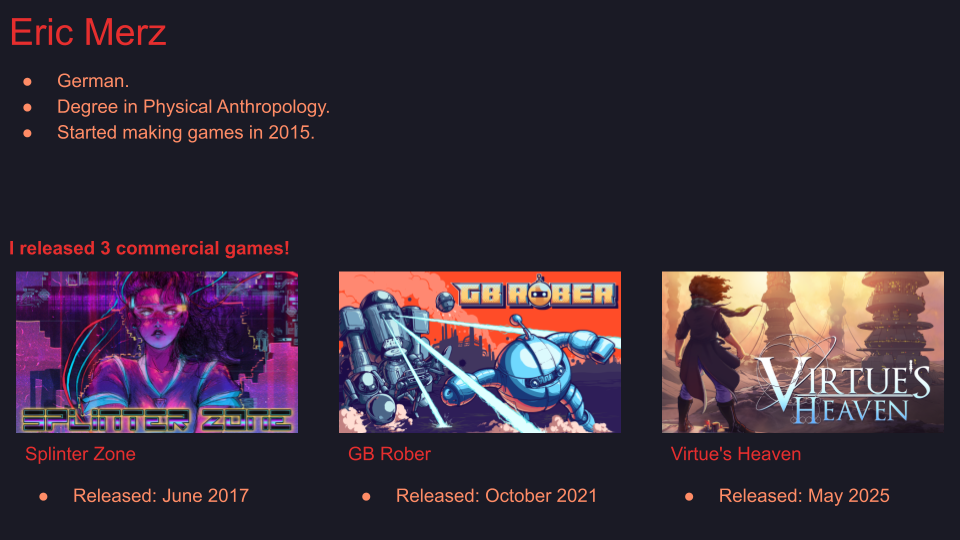
My name is Eric Merz and I’m a Game Developer from Germany.
I have no formal education in Game Design, or any related field. I came to that whole "do something creative" thing comparatively late in my life. My actual educational background is in physical Anthropology, specifically human evolution and primate morphology. However, outside of Academia the Job prospects for people with that type of degree are rather grim and so, when I graduated in 2014, I found myself in a situation where I had to figure out what else I could do with my life and decided that teaching myself how to make and sell videogames would offer me more stable career options.
Let's just say that we all learn from the decisions we make in our lifes and that some don't work out the way you would've hoped. Nonetheless I did manage to release three commercial videogames since I started. The selling part of it all never worked out all that well for any of them, but I did still manage to make and release them and strangely enough throughout that have managed to stay attached to this space we call "videogames" for way over a decade now.
Anyway, I don't really want to talk about any of these things. What I actually want to talk about is this very special mouse I invented.
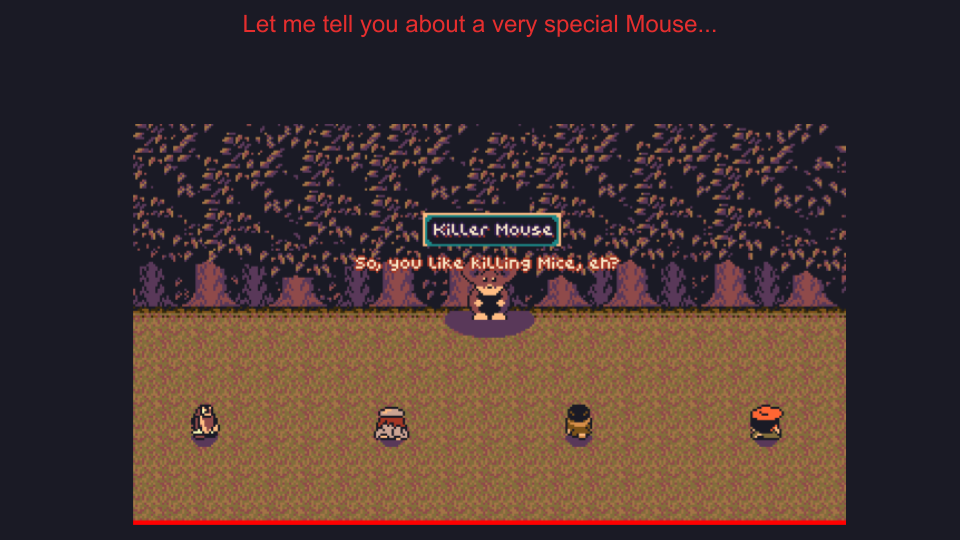
For the past year or so, I've been slowly building out a system that is supposed to help me create a series of JRPGs. This is primarily driven by an interest of mine in using JRPG battles as vehicles for dramatic storytelling, but also because I wanted to see if I can maybe transfer some stuff I picked up from playing smaller tabletop role playing games into a videogame RPG.
It is a very beautiful, convoluted mess of interlocking systems, but for the purpose of this anecdote, you only really need to be aware of three things:
Mice are vengeful creatures that will ruin your life if you provoke them.
Healing is just negative damage and gets handled via the same formulas as any other attack
When a character gets reduced to 0 hp, they receive bonus XP, based on the damage they just received.
As you can see, even though I'm a proponent of Evil Game Design, I do occasionally try to be nice to players.
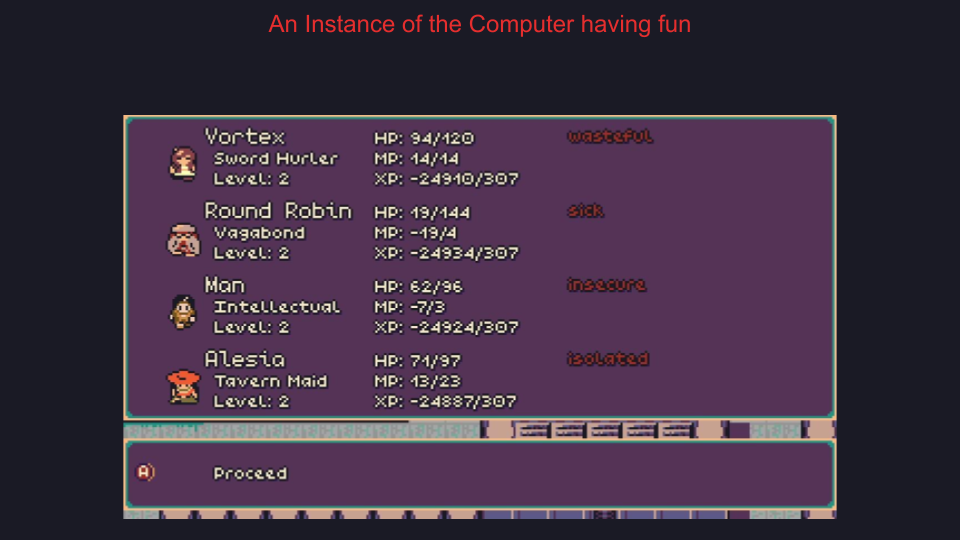
Emphasis on "trying", because, a few Months ago, I noticed during a playthrough that my party for some reason had -24000 XP
I never planned for this to happen. The game has other kinds of debts (I have played Dungeon Encounters, it is a huge inspiration for me), but "XP-Debt" was never on the menu. And yet for some reason it managed to weasel itself into this project. And the reason for that, has to do with those three rules I just mentioned interacting with one another in a way I didn't anticipate.
You might also say, this is an instance where the Computer had fun, potentially at the expense of the player.
You see, if you happen to run into this Mouse, which only shows up after you've killed other, less evil mice, and attack it, it will murder your party. It will do so via "healing damage". And because healing damage is negative, and it has to somehow be turned back into regular damage, some math happens and suddenly the entire party receives -24000 bonus XP as a reward for dying.
Now, most 'Good Game Designers' out there would tell you that this sounds like a problem and I have to admit: This was my first reaction as well.
You see, a lot of people who make games, regardless of scope, are conditioned to believe that specific emotional reactions are always more desirable than others.
Look up what is being said about the essence of "Good Game Design" and you find nuggets such as:
Good Games Respect the Player's time!
Good Games offer meaningful choices!
A Good Game maintains Flow (please remember that word)
Others say that it's the players who are supposed to have fun with a game, not its designer or the computer.
I even found one position that stated that players are supposed to be treated as gods.
The mere thought of leaving in this systemic oddity that puts players about 12 Levels worth of XP into debt right at the beginning of the game, feels almost like a crime.
It is important for us to understand that "Games as a Service" not only describes the specific, dominant business model we currently see, but also requires for games to be build around a specific set of ideas.
Ideas that generally speaking, always center the player's comfort and interests above anything else.
You could also say that the ideal "Good" videogame today is very similar to how one would design a Restaurant, where countless of service workers put an enormous effort into offering their customers an illusion of ease and comfort. This analogy is even further supported by the fact that in both cases, customers tend to react pretty rudely when said illusion is broken.
Videogames has further problems in that it very often attributes competence with financial success. A Game is well made, its designers, processes and perspectives worthwhile, only when their product leads to them, or their financiers, getting rich.
You could also say that what we call "Good Game Design", is actually "Industrial Game Design".
It chiefly treats games as products to be sold. As a set of rules one has to follow, or else be doomed to failure and economic precarity.
This idea of the "Good Videogame" as a perfect machine that rotates around its players has penetrated everything. Games criticism too cannot bring itself from getting past the idea that the ideal state of a game is that of a digital restaurant.
Idiosyncratic elements in a game are instead described as "Friction". Like a slightly under cooked steak, or a clumsy waiter, they're treated like quirky moments that remind us that what we are currently experiencing is the result of human labour.
To Summarize, the essence of "Good Game Design" is one that treats games as services and game designers as service providers.
Intentional or not, "Good Game Design" aims to hide the humanity of their creators and instead replaces it with a set of pre-defined, empty interactions that can be filled with aesthetics and themes to create a "Product".
And none of this is a new problem: Back In 2015, Lana Polansky made very similar observations in her Essay "Against Flow" and came to the following conclusion:
Where flow has become a shorthand for numbed subjectivity— particularly in the act of playing—and where this numbed subjectivity is elevated as an ideal player response, we have a crisis. It means those intrepid developers who are crafting provocative, dissonant, emotionally challenging games are classified not only as less marketable, but as fundamentally irreligious to the prevailing wisdom of what a good game is supposed to be.
It means that the discourse and culture around games arbitrarily limits itself, and tacitly suppresses any lesser known work (or any aspect of a well-known work) which doesn’t buttress that ideology.
It creates a climate where experimentation and appreciation of the form’s potential toward influencing different affective experiences is largely unsupported. But when we play, we feel. We should not be numb to this reality, forever in a meditative stupor, but active and aware of it. It’s real, and it’s vital that we embrace that.

If you want to read this essay today, you have to use the Wayback Machine, because the website that used to host it and more of her writing, is gone. This Crisis she mentions was allowed to continue. In fact, I'm of the opinion that things have gotten much, much worse since then.
Whatever cultural value may have once existed within independent videogames even back in 2015, has long been obliterated by financial interests and in fact it can be said that what we describe as "Indiegames" in the year 2026, is a deadzone in the sense that Max Haiven described it in his book "Revenge Capitalism".
Commercial Indiegames grew out of existing Amateur- and Hobby communities of the 2000s.
Those spaces were financialized and obliterated both by the advent of digital distribution platforms and specialised "Indiegame" Publishers.
Over time, Indiegames then shaped themselves more and more around the needs and requirements of both entities.
Try to find a Gamedev community today that isn't full of tiny business people trying to do tiny business things.
Other Game Developers, are primarily seen as unwanted competition. The entire narrative of the "Indiepocalypse" purely hinges on the idea that the influx of games from smaller creators somehow causes those with more means to earn less money.
The shape of Indiegames in the year 2026 is that of a corpse, driven by financial interests, keen on producing a never ending chain of repetitive, empty interaction machines and to exist within it, either means death, or to be turned into one of the worms that pilot it.
The Deadzone is everywhere and self-driven. It exists within us, too.
In order to escape it, we first need to reject the things that kill us.
If the existence of "Good Game Design" contributes to the continued existence and proliferation of this deadzone, then it needs a counter part, one which we will call:
"Evil Game Design"
While Good Game Design is interested in shaping games as products and services, Evil Game Design is interested in games as statements.
Evil Games do not center the player. They might acknowledge them, but only as far as it is deemed necessary.
Evil Game Design is about taking all the elements that are supposedly undesirable in a game and asks:
What if we make games that are frustrating, confusing and obtuse?
What if we make games where players get to be the architects of their own misery?
What if we make games that occasionally refuse to give players the things they want?
What if we make games that are ambivalent in their message?
What if we treat Game Design as an intentional creative process, and not as a set of rules?
What if we make games that proudly display their creator's humanity, instead of hiding it?
If videogames are a medium of communication, than Evil Game Design is meant to give their designers a bigger voice.
To go back to my example: I've commited the crime! I kept the negative XP. I actually put a cap on it, but during the process of writing this talk, I realized that I have been a coward. If I am to commit myself to evil game design, then I might as well fully commit to it.
I'm not doing this out of malice. I'm doing this, because I want players to stumble into situations that potentially lead to hours of misery. I want this to happen, because I'm also deeply interested in seeing them crawl back out of them.
And I'm not going to let a Sid Meier quote, or some dork with an email newsletter who yells about how you're supposed to design games around the tastes of the "average Steam user" get in the way of exploring the wounderful space that might open up, when you let someone suffer from their own mistakes.
A lot of essays and talks about the state of videogames culture and game design at some point say "Games could be so much more!", when in fact they already are.
The work is already being done, different approaches to game design, production and distribution already exist. Most of what I just said, has already been said several times over.
However, as long as we cling to this idea that a videogame can only ever be a product, or a service, we will continue to ignore the things that might point us towards a better future.
Whatever exists right now is utterly hostile towards any kind of work, that does not fit into a very small set of rules.
We could see that in some of the reactions to the most recent Manifesto Jam, where parts of the videogames "community" seemed to be utterly confused by the sheer number of people who voiced both, their displeasure with the status quo, but also expressed their hope that things could indeed be different.
Considering the times we live in, I might end up eating my words here, but at least as of right now:
You will not be put in jail, if you make a game that is deliberately obtuse and frustrating to play, or whatever other shape you want it to be, because every single rule of what constitues a "good" game is made up.
We often forget that we are human beings.
We make our own worlds,
and we make our own rules.
And while this isn't strictly a call for you all to become Evil Game Designers and Evil Game Critics, I do want to point out that a lot of things, sound much cooler and devious, when you put the word "Evil" in front of it. So maybe give it a thought.
But I also want to be clear that if you're already doing this kind of work, you don't have to do anything. Please, if you can, keep building the future we all want, and leave the worms behind.

That's it from me. This is where you could find me on the Internet:
I do have a Blsky account you could follow, as long as that place is still around. I do also have an Email Newsletter and you could even put my Blog into your RSS Reader that I assume you have by now. The Internet is dying, you should have an RSS Reader.
You could also buy my games! They're both on Steam and itch, but in the interest in being a conflicted individual: I do prefer if people buy my games on Steam, because it's much easier for me to get the money. My most recent game came out last year, it's called Virtue's Heaven and considering what a pain it was to make it, I think it turned out quite allright I think?

And with that, I thank you for your time, and I thank the organisers for giving me this space. As I said: People like me usually don't get to talk about Game Design, so I really appreciate the opportunity.
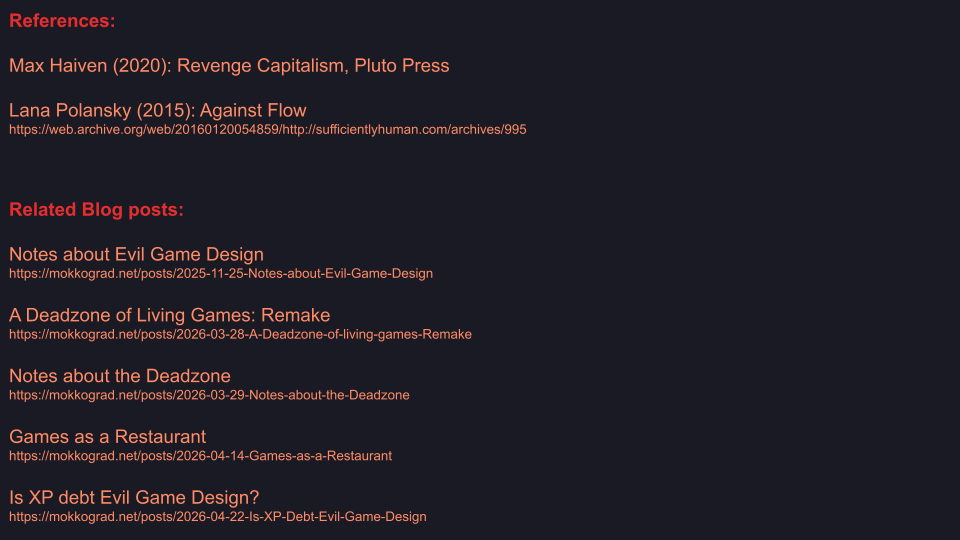
And here's some stuff for you to read, if you're into that kind of thing.